


India's Push for Rafale Combat Readiness Signals a New Era in Indo-Pacific Airpower

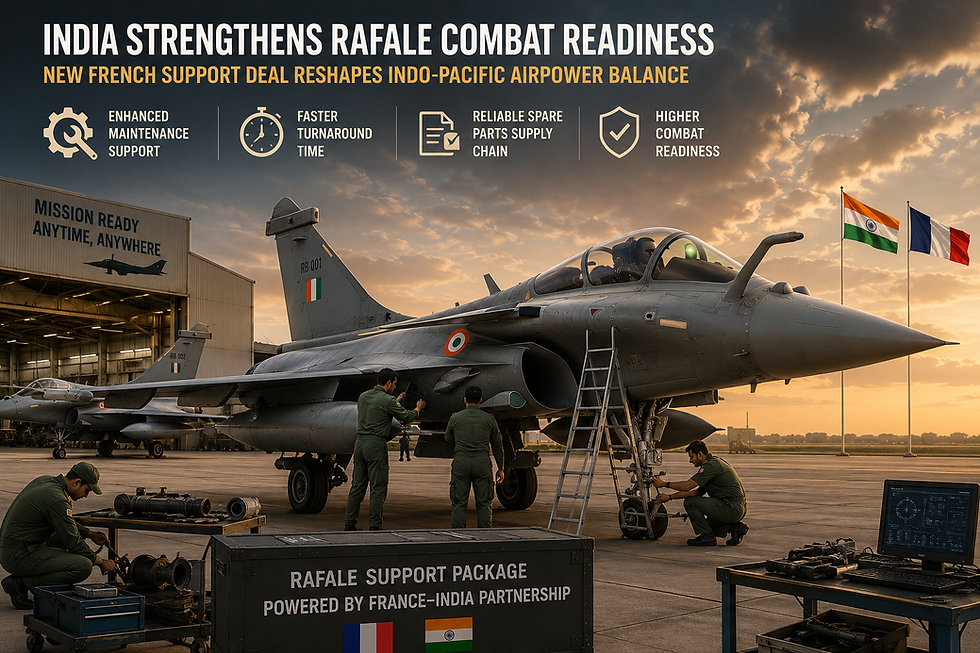
India is moving beyond simply acquiring advanced fighter aircraft—it is now focusing on ensuring that its Rafale fleet remains combat-ready at all times. Reports of a new long-term French support arrangement highlight a strategic shift from platform acquisition to sustained operational capability, a factor that could significantly strengthen the Indian Air Force's position in the Indo-Pacific.
The Indian Air Force currently operates 36 Rafale fighters, while the Indian Navy has also signed a deal to induct 26 Rafale Marine aircraft for deployment aboard INS Vikrant. Alongside these inductions, India is advancing plans to procure another 114 Rafale fighters under the Multi-Role Fighter Aircraft (MRFA) programme, making it one of the largest fighter acquisition projects in the country's history.
However, modern airpower is determined not just by the number of aircraft in service but by how many are available for combat at any given moment. Fighter jets require regular inspections, software updates, engine maintenance, spare parts, and rapid repair capabilities. Without a robust logistics and maintenance ecosystem, even the world's most advanced aircraft can spend significant time grounded.
This is where the proposed French support framework becomes strategically important. By ensuring faster availability of spare parts, technical assistance, maintenance infrastructure, and performance-based logistics, India aims to maximise the operational availability of its Rafale fleet during both peacetime and crisis situations. Reduced maintenance delays translate directly into higher sortie generation rates, allowing the Air Force to sustain combat operations for longer periods.
The initiative also aligns with India's broader objective of strengthening defence self-reliance. Discussions surrounding the proposed 114-aircraft deal increasingly emphasise local manufacturing, technology transfer, indigenous weapon integration, and greater domestic industrial participation. Reports suggest that the majority of these aircraft could eventually be manufactured in India in partnership with French industry, significantly boosting the country's aerospace ecosystem.
Strategically, the timing is significant. The Indo-Pacific has emerged as one of the world's most contested military theatres, with rising competition among regional powers driving rapid military modernisation. By combining advanced Rafale fighters with reliable long-term logistical support, India is building an air force capable not only of deterring adversaries but also of sustaining high-intensity operations over extended periods.
Ultimately, this development reflects a broader transformation in India's defence planning. Future conflicts will be decided as much by logistics, maintenance, and industrial resilience as by advanced weapon systems themselves. By investing in long-term Rafale combat readiness rather than merely expanding fleet numbers, India is laying the foundation for a more resilient, self-reliant, and strategically capable air force in the decades ahead.


Comments