


Why India’s Push for an Indigenous TPE331-Class Engine Could Become a Major Aerospace Breakthrough

India’s defence aviation sector is gradually moving beyond the stage of simply manufacturing aircraft and is now focusing on one of the most difficult areas of aerospace technology: engine development. Recent discussions around the need for an indigenous turboprop engine in the Honeywell TPE331-12B class highlight an important reality—true aerospace self-reliance cannot be achieved without domestic propulsion technology.
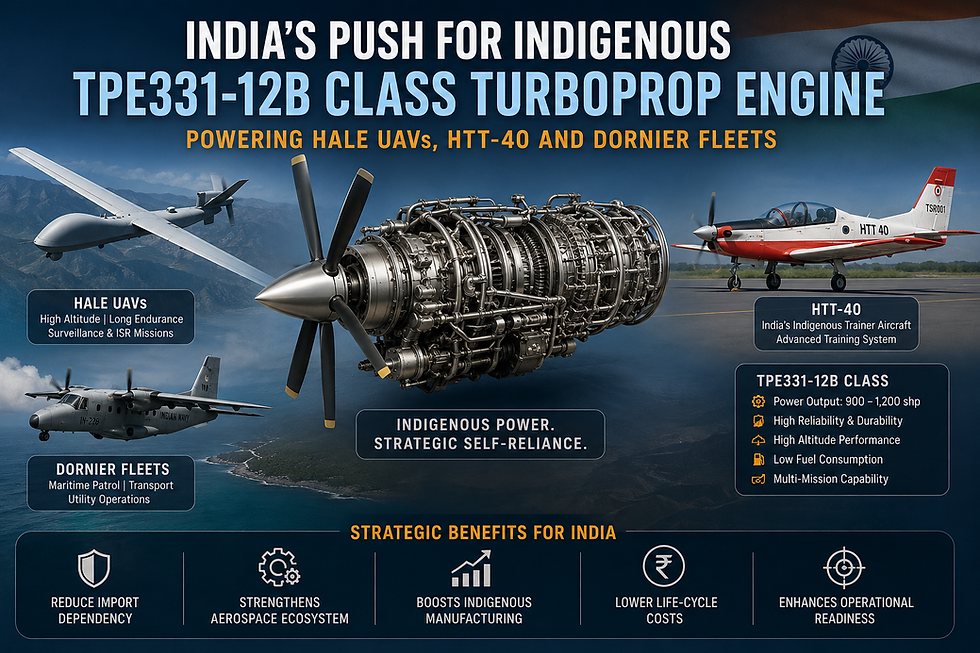
The TPE331-12B engine currently powers the HTT-40 basic trainer aircraft developed by Hindustan Aeronautics Limited (HAL). It is also closely linked to future requirements involving high-altitude long-endurance (HALE) unmanned aerial vehicles and potential upgrades for India’s Dornier aircraft fleet. While these platforms are either indigenous or heavily localized, their dependence on foreign engines continues to create strategic vulnerabilities.
This challenge became visible during the HTT-40 programme itself. Delays in engine deliveries from Honeywell affected production timelines and slowed aircraft deliveries despite the platform being ready for induction. The episode demonstrated how even a successful indigenous aircraft programme can face setbacks if a critical subsystem remains dependent on overseas suppliers.
An indigenous engine in the 1,000–1,200 horsepower category could solve multiple problems simultaneously. It could power future Indian HALE drones designed for long-duration surveillance missions, support the growing HTT-40 trainer fleet, and modernize Dornier aircraft used for maritime patrol, transport, and utility operations. Instead of maintaining separate foreign-dependent supply chains, India could create a common propulsion ecosystem across several aircraft categories.
The strategic benefits extend far beyond logistics. Developing such an engine would help Indian engineers gain expertise in advanced turbine materials, digital engine control systems, thermal management, fuel efficiency optimization, and high-altitude performance engineering. These are foundational technologies that can later contribute to larger turboprop, turboshaft, and even future civil aviation engine programmes.
The timing is also important. India is investing heavily in indigenous drones, military trainers, surveillance aircraft, and aerospace manufacturing infrastructure. As these programmes expand, dependence on imported engines could become a long-term bottleneck. Global supply chain disruptions, export restrictions, and geopolitical tensions have repeatedly shown how critical technologies can become difficult to access when needed most.
An indigenous TPE331-class engine would therefore represent more than a new aerospace product—it would be a strategic capability. It would strengthen operational readiness, reduce long-term maintenance costs, improve supply security, and support the broader vision of Atmanirbhar Bharat in defence aviation. The knowledge gained from such a programme could also benefit civilian aviation, regional transport aircraft, and specialized industrial applications in the future.
India’s aerospace ambitions are growing rapidly, from advanced fighters and surveillance aircraft to next-generation UAVs. However, history has repeatedly shown that aircraft are only as independent as the engines that power them. If India succeeds in developing a reliable indigenous turboprop engine in this class, it could become one of the most important yet underappreciated milestones in the country’s long-term aerospace journey.


Comments