


TRIYAM-3D AI Air Defence System: India’s Autonomous Answer to Drone Warfare

India’s battlefield is evolving — and so are its threats.
From surveillance drones to coordinated swarm attacks, modern warfare is no longer limited to fighter jets and missiles. And now, India has unveiled a system designed specifically for this new era: TRIYAM-3D, an AI-powered autonomous air defence platform.
This isn’t just another weapon. It’s a shift in how wars could be fought — and won.
What is TRIYAM-3D?
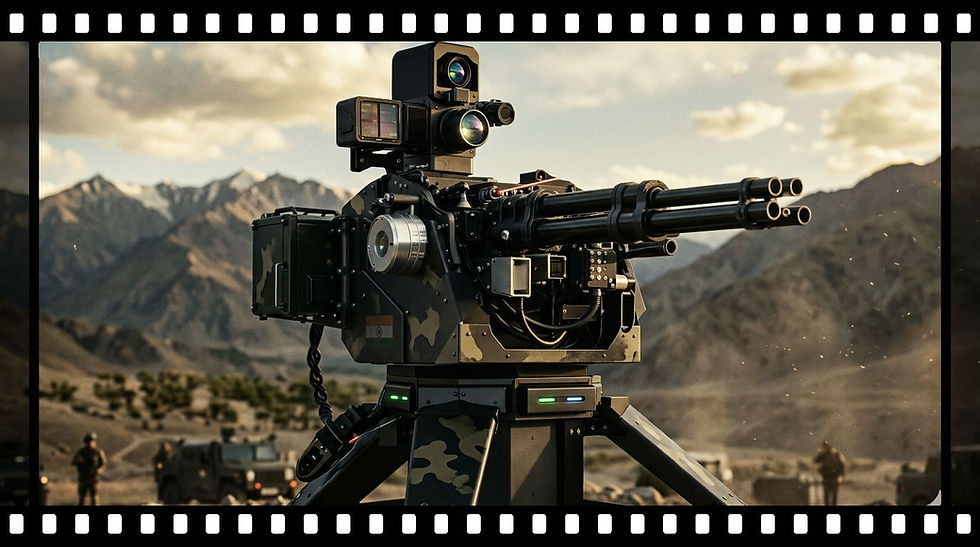
TRIYAM-3D is an indigenous autonomous air defence system designed to detect, track, and neutralize aerial threats — especially drones and swarm attacks — in real time.
Developed with advanced technologies like:
Artificial Intelligence
Deep Learning
Multi-sensor fusion
Swarm robotics
the system can operate with minimal human intervention.
In simple terms, TRIYAM doesn’t just react — it thinks, identifies, and acts on its own.
India’s Autonomous Gatling Gun Concept
What makes TRIYAM unique is its integration with rapid-fire weapon systems, similar in concept to a Gatling gun.
During trials, the system was paired with a light machine gun and tested in operational conditions near India’s northern borders.
This setup allows TRIYAM to:
Engage multiple targets simultaneously
Counter fast-moving drones
Handle swarm attacks with precision
In modern conflicts, where dozens of drones can attack at once, this capability becomes critical.
Why This Matters: The Drone Threat
Drone warfare has changed everything.
From low-cost kamikaze drones to coordinated swarms, adversaries can now overwhelm traditional air defence systems.
These threats are:
Fast
Hard to detect
Extremely scalable
Traditional missile-based systems are expensive and not always efficient against such targets.
TRIYAM-3D addresses this gap by offering a cost-effective, AI-driven countermeasure — one that can operate continuously and respond instantly.
A Step Toward Autonomous Warfare
Globally, nations like the US, China, Israel along with Russia are investing heavily in autonomous weapons.
With TRIYAM, India is entering that league.
The system represents:
A move toward AI-driven combat systems
Reduced dependence on human operators
Faster decision-making on the battlefield
More importantly, it aligns with India’s push for indigenous defence innovation.
The Bigger Picture
TRIYAM-3D is not just about stopping drones.
It reflects a broader transformation in India’s defence strategy — one that focuses on:
Automation
Real-time response systems
Scalable and cost-efficient defence solutions
As drone warfare becomes more dominant, systems like TRIYAM could become the first line of defence.
Conclusion
The future of warfare is autonomous, fast, and data-driven.
With TRIYAM-3D, India is not just preparing for that future — it is actively building it.
Because in modern warfare, victory won’t just depend on firepower.
It will depend on how quickly your system can think, decide and act.


Good Explanation 😃